About Anja Marais

This author has not yet filled in any details.
So far Anja Marais has created 128 blog entries.

From ‘Studio Decisive Moments’

A Review by student Chrissy B. from the blog ‘Studio Decisive Moments’ of ” Tenterhooks” an exhibition by Karley Klopfenstein and Anja Marais at St. Mary’s School of Maryland’s Boyden Gallery.

“….The dual exhibition showcased the work of Anja Marais who is an artist from South Africa who works with sculpture and the theme of storytelling and life passages in her work. Although she currently resides and works in Florida, Marais has artwork and publications all over the country. As her biography states, “ Through an ancestral portal she examines the fragility of life by creating biosphere content that touches on themes of cyclical elements of fauna and flora, memories, genetics and life-death.” This is very true with Marais’ work that she presented in the exhibition, with sculptures of the human head and torso attached to strings and other fabric materials. One specific sculpture showed a man’s head upside down, attached at the neck by a tied rope hung off the ceiling. The sculpture is hand sewn and Marais explained how she sews on each small portion of fabric to make the surface of the sculpture actually resemble that of the human skin. This, as well as glass eyes bought from a taxidermist make the sculpture resemble the human forms of life and death; it’s on the edge of reality but also on the verge of unreal. When I spoke to Marais, she actually said that this was something she was trying to get across in her artwork. Behind this particular piece was a collage of the different pieces of numbered fabric, pasted onto a sheer cloth with hints of blue water-like shapes. When you stand back and look at the work, it looks like a person submerging themselves into the water; its abstraction and beauty really do contradict each other, but give it almost a sort of nostalgic feeling. …” ~ Chrissy B

By |2017-07-11T00:09:17-04:00November 25th, 2010|

Guide and Review for “Flow of Thoughts”

Edit: We were also mentioned in the Korean Herald.

Text by Juhee Youn, English Translation by Hyemin Son. On http://neolook.net/

패트리샤 토마와 아냐 마레이스의 전시 가이드 하기 ● “어디나 우리는 선으로 연결되어 있습니다. 그 선은 때로 눈에 보이기도 하고 보이지 않기도 합니다. 또한 그것이 전혀 다른 지점을 연결하는 선으로서 위치하게 될 때 지속적인 형태를 띠게 되며, 어떤 경계를 표시할 때는 정적인 형태를 띠게 됩니다. 뚜렷한 목적이 있는 선일수록 그 선의 모양은 단순화 되고 최대한 짧게 표시되며, 그 반대의 경우는 선도 시작과 끝점이 쉽사리 보이지 않을 정도로 복잡해지고 엉켜서 때론 만나기도 하고 겹쳐지기도 합니다.

여러분은 자연스러움에 대해 익히 듣고 있을 것 입니다. 그것이 지금 인간을 위한 최선의 선택이고 미래를 위한 완벽한 선택이라고 말들 합니다. 이렇게 자연스러움은 21세기 커다란 화두입니다. 뚜렷한 목적을 향해있는 단순화 된 선으로만 가득 차 있는 도시에, 자연으로부터 나온 듯한 유연한 선들을 더해줌으로써 도시 안에서 자연스러움을 만들어 가고 있습니다. 하지만 자연스러운 것이라는 건 철저히 자연과 동일해질 수 없다라는 사실을 아이러니 하게도 강하게 전제하는 것이 됩니다. 즉 그 자연스러워 보이는 유연한 선들은 자연스러워야 한다는 강박관념하에 선명해지며 시작점과 끝점이 눈에 들어오기 시작합니다.

여기 두 작가들은 목적이나 계획들로 인위적으로 다듬어지고 단순화 되어가는 서울을 자연스럽게 돌아다녔습니다. 그리고 정확한 목적이나 어떤 선입관 없이 이 도시를 찬찬히 관찰하고 기록하고 마주하게 되는 상황에 자연스럽게 반응했습니다. 그들이 서울을 이해해나가는 방식은 출발점과 도착점이 서로 모호하게 얽혀있는 선 같았습니다. 그러나 있는 그대로를 보겠다는 태도 자체가 인위적인 의도를 드러내는 것이기 때문에 이들의 존재는 눈에 들어오기 시작합니다. 또한 그들의 자연스러움과 우리들의 자연스러움이 결코 같지 않기에 그 존재는 더 확실히 인식되기 시작합니다. 마침내 그들이 자연스럽게 반응하여 풀어낸 서울은 전혀 우리가 경험해보지 못한 낯선 서울로 다가오게 됩니다. ■ 윤주희

A Guide for Anja Marais and Patricia Thoma Exhibition ● In our daily lives, we are connecting with lines like roads, networks and rivers. A line could be visible and also invisible. It can connect two different spots and appear as a continuous form or it can mark a boundary and can appear as a static form. A line with a certain purpose is often designed as being quintessential and simplified, or it can become complex. A big snarl-up to mix the beginning and the end, sometimes to meet and to overlap each other. ● As we familiar ourselves with the idea of getting ‘being natural’, it suggests one of the best alternatives for humanity and a perfect choice for our future. Currently, ‘being natural’ is the great agenda of the twenty-first century. In a city, full of straight simple lines performing certain functions,it transforms into becoming natural by adding various fluid lines copied from nature. Ironically, ‘being natural’ is strongly premised on the assumption that it cannot be identical with nature. The more we obsess in becoming natural the more fluid lines emerge and clarify. ● Anja Marais and Patricia Thoma are here to stroll around Seoul which is getting simplified and polished artificially upon objectives and city-plans. Without a clear purpose and any prejudice toward Seoul, they are observing slowly, documenting and responding to this city. It seems that their approaches to understand Seoul are similar to tangled lines to blur the distinction between their starts and ends. However, to observe the matter without a prejudice and a purpose is also an obvious intention. From that point of view, we could have a glimpse of their existences. Their naturalness is different from our understanding of naturalness so that we could see two artists’intention more precisely. Finally, Marais and Thoma’s natural responses to Seoul offer us unfamiliar Seoul that we have never experienced before. ■ YOUNJUHEE

Related posts:
“The Opposite of Nature is impossible”
“Flow of Thoughts”, A Two Person Exhibition in Seoul
Progress at residency:week 2
Progress at residency: week 1

By |2017-07-11T00:09:18-04:00June 29th, 2010|

Meeting Eriko Horiki [Pic].

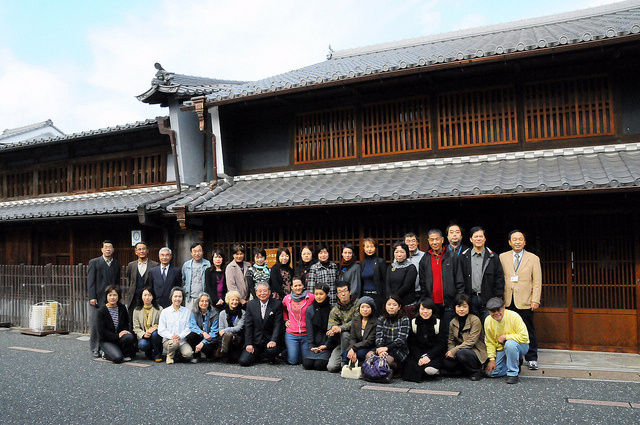
Etsuko Tsuji send me this photo today, thanks.
Left to Right>Etsuko Tsuji, Marlis Killerman, Mari Doigawa, Eriko Horiki , me, Jeanne Jaffe

We attended a lecture by Eriko Horiki, (her website) she however did not give any of her paper techniques away but she did say the following about her art and techniques which I found interesting (translated from Japanese)

I always pursue what seems impossible and that I ‘cannot’ do, instead of what I am already capable of doing. The energy of this process becomes very important to me.”


By |2017-05-02T13:07:38-04:00March 24th, 2010|

Living in the Henry Faulkner House.

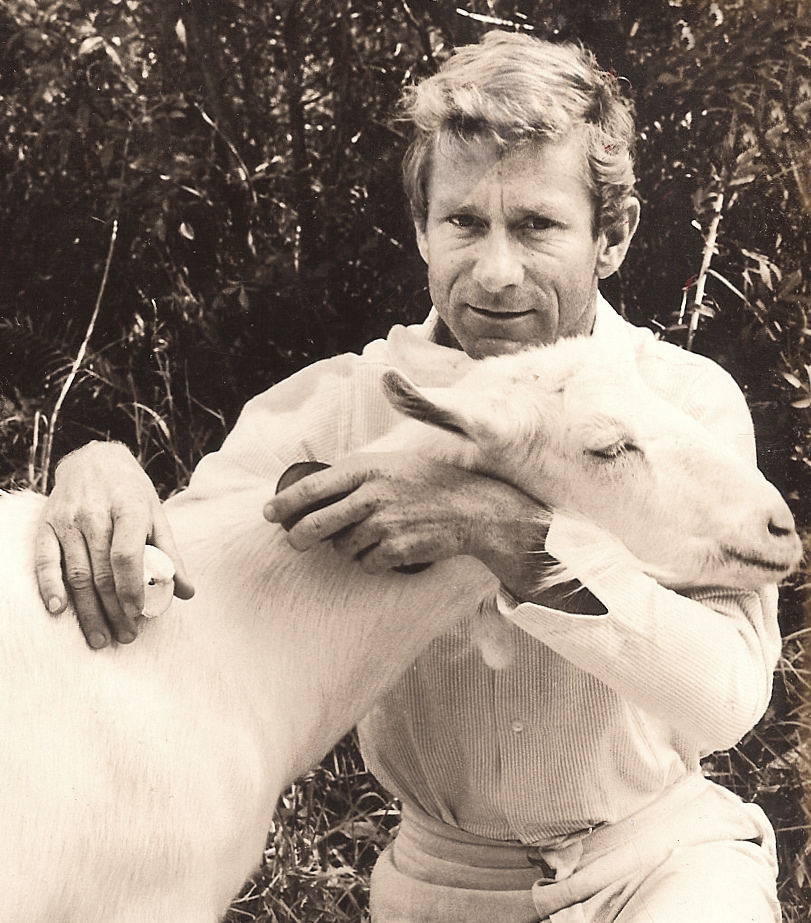
Artist Henry Faulkner and his beloved goat Alice in 1964.

I am living on a quaint lane in Old Town Key West for the last six years in a wooden Victorian house. My first impression walking in as a tenant-to-be was the “good feeling” that oozed out of the old Dade County Pine. Standing sturdy like a ship on land it already embarked on a journey a long time ago and I just happened to board on one of its many pit stops.  I would come across small odd clues and reminiscences hidden and cradled in wood of forgotten ghosts and on an Easter hunt I started collecting questions. Why is there different layers of bright neon green paint under the dull brown fresh painted floors? Why is there a photo of man with a goat staring at me from its buckled copper frame? Why is the house full of antique gaudy Italian carved mirrors with crumbling flying cherubs? This is how I got acquainted with Henry Faulkner, his art and his flagrant life.

Henry Faulkner was born in Egypt, Kentucky in 1924 into a sad childhood that has the makings of an Edgar Allen Poe tale. From a volatile father to the slow death of his mother his sensitive nature was formed and overcast by becoming an orphan dumped into the welfare system moving from one to the other foster family. He even had a foster-mother in the remote Appalachian that treated him like a girl that she rather wanted. His  adult life was peppered with debilitating incidents like being mugged with a hammer as an adult with a blow to the head, discrimination against being gay that included slurs and beatings and after all these setbacks any other human might have sunk into self-pity, but not Henry. His insecurities and pain poured like syrup into manifestations of poetry, art and a flamboyant lifestyle. He became best friends with Tennessee Williams, the Bertolt Brecht family and befriended Ernest Hemingway. In his Key West days he became the life and heartbeat of many parties and art gatherings.

He also become the savior of the outcast and forgotten, any animal that he could find abandoned and tortured he will rescue and become part of his own bizarre family that included Alice the goat. The rumor goes that he had painted the floors in the house green so that Alice can feel more at home “galloping  through pastures”. He wrote numerous poetry and was a prolific painter. His paintings reminds me of Marc Chagall,- see more of his paintings. He passed away in 1981 when his car was hit by a drunk driver. If you want to learn more about this amazing artist you should read The Outrageous Life of Henry Faulkner” by Charles House.

Currently this house is in the Bertolt Brecht family trust since his son Stefan and Henry Faulkner were good friends. We are the temporary caretakers of this property. It is one of the last untouched houses in Key West that stayed exactly the same for the last 5 decades without any editions or changes. It still has a well on the yard and the kitchen is separate from the house, built to prevent the spread of fire.  There was even  a couple of movies shot in the house like ‘Criss Cross with Goldie Hawn in 1992 (not a great movie. . .). I was told by a neighbor, that has lived on the lane his whole live, that Henry Faulkner and Tennessee Williams had major parties. The two will sit on the front balcony and some navy sailors will parade down the lane and only the selected ones were allowed to enter to join the party. No wonder the house has good vibes!

I cringe for the day that this house will be turned into the rest of Key West now sterile “Meringue cake” houses that are buffed and overly manicured by rich out of towners. But for now I enjoy the character of “Old Key West” the days of poets, hippies and famous writers. When I work in my studio I feel a solidarity almost as if Henry is peeking over my shoulder with that sweet ‘Mona Lisa’ smile of his.

By |2017-05-02T13:08:30-04:00March 15th, 2010|
Go to Top