The man on the top of the mountain

Notebook Entry: Miami 2010

We all at some point desire to seek out the wise man that is sitting on top of the mountain listening to our burning questions. Lets say I have found such a man. I would brace the acid cold and climb over steep plateaus to reach him.

Here is Giovanni Segantini (1858 – 1899) on what is art:

“Art should lead us up to that spiritual sustenance which is as yet unknown to the mass of mankind, and which will constitute at once the delight and the torment of future generations. Art without an ideal is but nature without life. . . there are two ways to see art, that may serve as a starting point, although they are entirely opposed to each other. First that truth which is outside ourselves is not art, it has not and cannot have any value as art ; it is but a blind imitation of nature, and could not be anything else ; hence it is a purely material representation. Matter should be elaborated by mind if it is to rise to the form of art which endures.
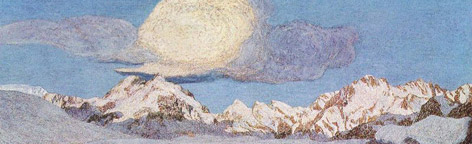
The second is that the lasting value to a work of art is the blind imitation of nature : All that the painter has added of his own, the so-called personal interpretation, the arbitrary variations, and the comments on nature, die ; while what he has reproduced sincerely and truthfully, exactly as he saw it in nature, lives for ever, and the furthest ages will joyfully welcome it as a work of art, as a good old friend, as never-changing nature.

It is indeed true that an ideal which is outside nature cannot last, but a reality without ideals is realism without life. Those works of art in which the artist has ‘reproduced’ the soul in the living and perceptible form, not the artist’s own soul, but that of his subject, of him or of her whom he was reproducing. This form of art, although impersonal, is nevertheless highly spiritual, and not a mere material reproduction : matter was but a means to the end. We almost invariably find this form of art in portraits painted by the great masters of all ages, and it is here that they have attained their greatest power, a portrait being a work which combines the highest simplicity of means with the greatest effectiveness in the art of expressing the living and perceptible form.Thus a work of art can only be expressed in a living form, either by expressing the personal feeling of him who created it, or the living sense of nature. . . .Tell me what else is art, beautiful, true, noble art, but the photographic image, the measure that marks the degrees of the perfection of the human soul ?
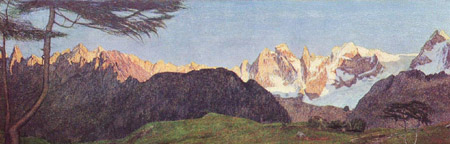
It is not merely by means of the beauty of nature in the abstract that we can create a work of art. This creation is possible only through an impulse of the spirit or human soul. When we feel the idea of art quickening within us, and we give to it all our faculties until it be ripe, it will be as if a flame suddenly warmed and illumined our soul : the power of this flame is irresistible, and the work of art is born and full of vitality this we deduce that beauty exists in nature because we see it and feel it, and the manner and measure of our feeling are in proportion to our spiritual capabilities. Thus a work of art being an interpretation of nature, the more spiritual elements it contains and reproduces with sentiment and dignity of form, the further is it removed from the perception of the common herd. It cannot be appreciated save by those who by means of long and patient study have succeeded in raising their spirit to the perception and assimilation of those spiritual elements.

These two definitions of art has led to the following results. When the artist wished to render universal an idea of his own, he had to take into account the intelligence of the masses, and consequently adapt himself to the tastes of others, that is to say, to the taste of his day. An universal feeling or an idea of one’s own by means of an artistic presentation, or to reproduce artistically a universal feeling or idea, by which the artist’s soul was impressed.’If, on the other hand, the artist was impressed by an idea or a feeling that was universal, and he wished to consolidate it in an artistic form, he could neither follow the free impulse of his genius, nor see the idea which had inspired his work sublime and glittering in its own full brilliancy. Freedom of form and of personal sentiment disappear, the ideal impulse of the artist having been quenched,corrected, and adapted to ideas determined by others..In art it is absolutely necessary to blend realism with idealism.
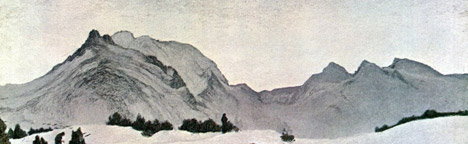

Art should reveal sensations that are new to the spirit of the initiated : the art which leaves the spectator indifferent has no reason to exist. The suggestiveness of a work of art is in proportion to the intensity with which it was felt by the artist in conceiving it, and this is in proportion to the refinement, the purity, as we may call it, of his feelings. In this way the lightest and most fleeting impressions are rendered more intense and become fixed in the brain, moving the higher spirit that synthetises them, and making it fruitful ; hence comes that elaboration which translates the artistic ideal into a living form. To preserve this ideal vision while executing his work, the artist must summon up all his powers, so that the initial energy may continue active; it is a vibration of his nerves which are intent on feeding the flame, on keeping alive the vision by constantly recalling it, lest the idea should dissolve or fade, that idea which should become alive on the canvas, creating the work that will be spiritually personal and materially true. Not true in the external, superficial, conventional sense, which is the stamp of common art, but true in the sense of that truth, which goes beyond the barriers of superficial lines and tones, and gives life to form and light and colour.

This, then, is realism. It enters into the soul and becomes part of the idea. The brush sweeps across the canvas and obeys ; it shows the quivering of the fingers in which all the nervous vibrations are concentrated ; the different objects, the beasts, the birds, the human beings are born, and take shape, light, and life in all their smallest details. The flame of art is in the artist, and by means of the tension of his soul it maintains in him the emotion which he communicates to his work. Through this emotion the mechanical, toilsome effort of the artist disappears, and the complete work of art is created, all of one piece, living, perceptible ; it is the incarnation of the spirit in matter, it is a creation. Thus by creating a work of art we render our own soul more noble and perfect, and sometimes that of others as well.

From: *Luigi Villari, Giovanni Segantini. London, T.Fisher Unwin, 1901, pp105-119. All images details from Segantini’s paintings.
By |2017-07-12T13:04:37-04:00August 22nd, 2011|

For when the brush is heavy, and the inkpot dry – from my studio wall.

“The quality that above all deserves the greatest glory in art -and by that word we must include all creations of the mind – is courage;…To plan, dream, and imagine fine works is a pleasant occupation to be sure . . .But to produce, to bring to birth, to bring up the infant work with labor, to put it to bed full-fed with milk, to take it up again every morning with inexhaustible maternal love, to lick it clean, to dress it a hundred times in lovely garments that it tears up again and again; never to be discouraged by the convulsions of this mad life, and to make of it a living masterpiece that speaks to all eyes in sculpture, or to all minds in literature, to all memories in painting, to all hearts in music, – that is the task of execution. The hand must be ready at every moment to obey the mind. And the creative moments of the mind do not come to order…And work is a weary struggle at once dreaded an loved by those fine and powerful natures who are often broken under the strain of it…If the artist does not throw himself into his work like a soldier into the breach, unreflectingly; and if, in that crater, he does not dig like a miner buried under a fall of rock . . the work will never be completed; it will perish in the studio, where production becomes impossible, and the artist looks on at the suicide of his own talent…And it is for that reason that the same reward, the same triumph, the same laurels, are accorded to great poets as to great generals.”

*Honore de Balzac, Cousin Bette. New York, Panttheon Books, pp236-8

By |2017-05-02T13:02:11-04:00July 14th, 2011|

Friendship with a dead sculptor…(ii)

We were walking along the edge of the ocean’s foam apron, water chasing our bare feet. Seaweed piled up in little pyramids on the sand, oozing sulfurous vapor that bit into the fresh air. With his big hands this hirsute man spoke as he gestured towards the skyline, saying that it is here in nature that he finds his savage muse.

In sculpture if you become too academic in poses and style, you are making an absentee of nature and thus life becomes absent from your work. We must unfreeze sculpture, life is the thing, everything is in it, and life is movement.

You should be at the order of Nature. A sculptor should take from life the movements that he observes but he should not impose them. Obey nature and do not command her and know that there is no recipe to improve nature, for it will become a lie. The secret is to ‘see’ her and not to just look at her.

The wind picked up and carried his words away but did not hinder his monologue.

What we commonly call ‘ugliness’ in nature can become full of great beauty in art. For the great artist everything in nature has character and that which has character is beautiful. That which is considered ‘ugly’ in nature in fact has more character for its inner truth shines through more so than that which we consider ‘beautiful’ in nature. Capturing this power of character in art makes the sculpture strong with value. There is nothing ugly in art except that which is without character, that lacks inner truth. That is why Baudelaire could make the festering corpse about love, why Velasquez could render the dwarf so touching.

As we stood under the shade of the palm trees he looked up and said that he is the confidant of these trees and this ocean;  they talk to him like old friends. But his eyes now caressed the golden bodies of the sunbathers embedded in the sand; their limbs oiled and stretched to harvest every single ray of light.

Do you see their living detail?

Somehow through the years I have stopped paying attention to the loud tourist but with new eyes I scanned their bodies. The surface of their skin’s slight projections and depressions, the body itself a multitude of almost imperceptible roughness. Every body curved into an attitude, a story.


*Grunfeld V. Frederic, “Rodin. A Biography” Henry Holt. 1987.
*Rodin, A “Rodin on Art and Artists” Dover Publications. 1983.
By |2017-07-12T13:05:39-04:00June 8th, 2011|

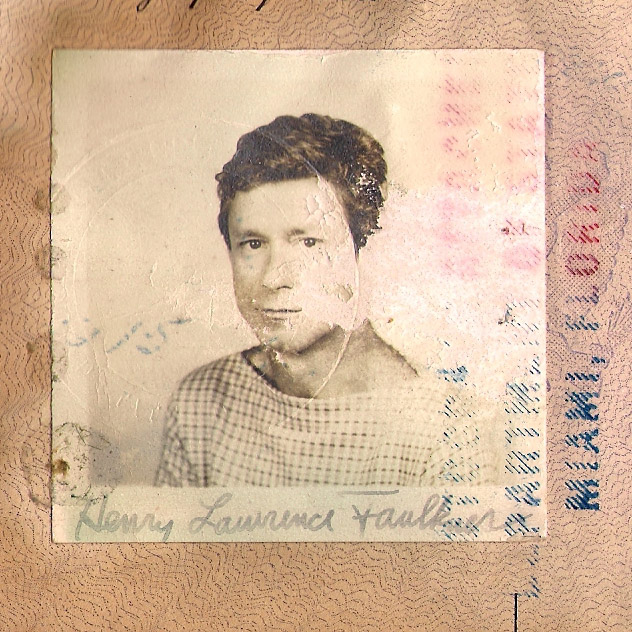
“Poetry is the bread of Children” by Henry Faulkner

Henry Faulkner

Henry Faulkner (1961)

Oh, and do you know the bread that poetry is?
The truth that is in a leaf;
that the tongue of God is in the bells of Sunday mornings.
and that Sunday is the smile of God.
That spring rains are full of sunny music.
The sun is the hair of God falling on the land.
Did you know that God was once creating children?
That He made a beautiful mistake
and called it honeysuckle…

Oh, and in the rivers that run down
under the Sundays of your sorrows
the dinner bells of happiness are drowned.
Somewhere children are hungry and in need of hope
and the winds of sorrow are crying along the corners
in their sorry tombstone-grey neighborhoods
the grass is only mocking, what might have been
but as tho’ they were eating some strange bread
The children of sorrow smile…
As tho’ smelling an apple’s strange sweet air.
They lift their heads and smile like morning
breaking through, because they now the taste
of the apples of goodness.

Oh, and children know, no matter how rich or how poor,
sad or happy, children know.
The taste of the bread of poetry.

~Henry Lawrence Faulkner (1924-1984)

Related article: Living in the Henry Faulkner House

By |2017-05-02T13:04:06-04:00June 8th, 2011|

Friendship with a dead sculptor…(i)


The Royal Poincianas are in full, blazing crimson bloom and, as I peer over my chipped porcelain teacup inhaling its dark aroma, the conversation starts.


It is a monologue that drifts over the static channels of more than a century but when he speaks his beard moves like a stiff, red, thatch roof. Barely two inches taller than me, we look at each other through a fog–not because of the curtain of time–but because of our weak eyes. Our sight is due to the unavoidable curse of a sculptor that works many hours transfixed and bent over his material in low light.


His hands–once called une main d’une prodigieuse vitesse–are moving restlessly when he speaks about how the power of observation should always be practiced…look at an object and fix that image in your mind and try to retain its memory as long as possible before you sketch it. When you are carving your object, never see the form in length but that of its width; a surface is always the extremity of the volume. He will lean forward in his chair to make very clear his point that it is all about the projection of the interior volumes. In each swelling of the torso or the limbs a suggestion of outward thrust is made by a muscle or a bone that is buried deep under the skin. Oh, and for god sakes do not brood over your failures too long for there is not much time; an intense nervous excitement should always drive you back into the studio and into your work but there is no need to hurry.


Wait a minute–what do you mean? I have to work with nervous excitement and fast hands; or there’s no hurry, so take it easy? Which one is it?


His fingers are now rolling a clay coil absentmindedly and he slowly utters that, a sculptor should be wild about working, getting up early, sketching non-stop, studying the masters, never be distracted for so much as a minute! But you always have time to make a beginning once you are sure of your subject; a sculptor can establish his or her reputation with a single piece of sculpture.


A silence falls between us that becomes filled with the songs of the cicadas, both lost in thought. I asked him if he will come back tomorrow?


*Grunfeld V. Frederic, “Rodin. A Biography” Henry Holt. 1987.
*Rodin, A “Rodin on Art and Artists” Dover Publications. 1983.
By |2017-07-12T13:05:40-04:00May 27th, 2011|
Go to Top